Hello Blob: Agar as Interface
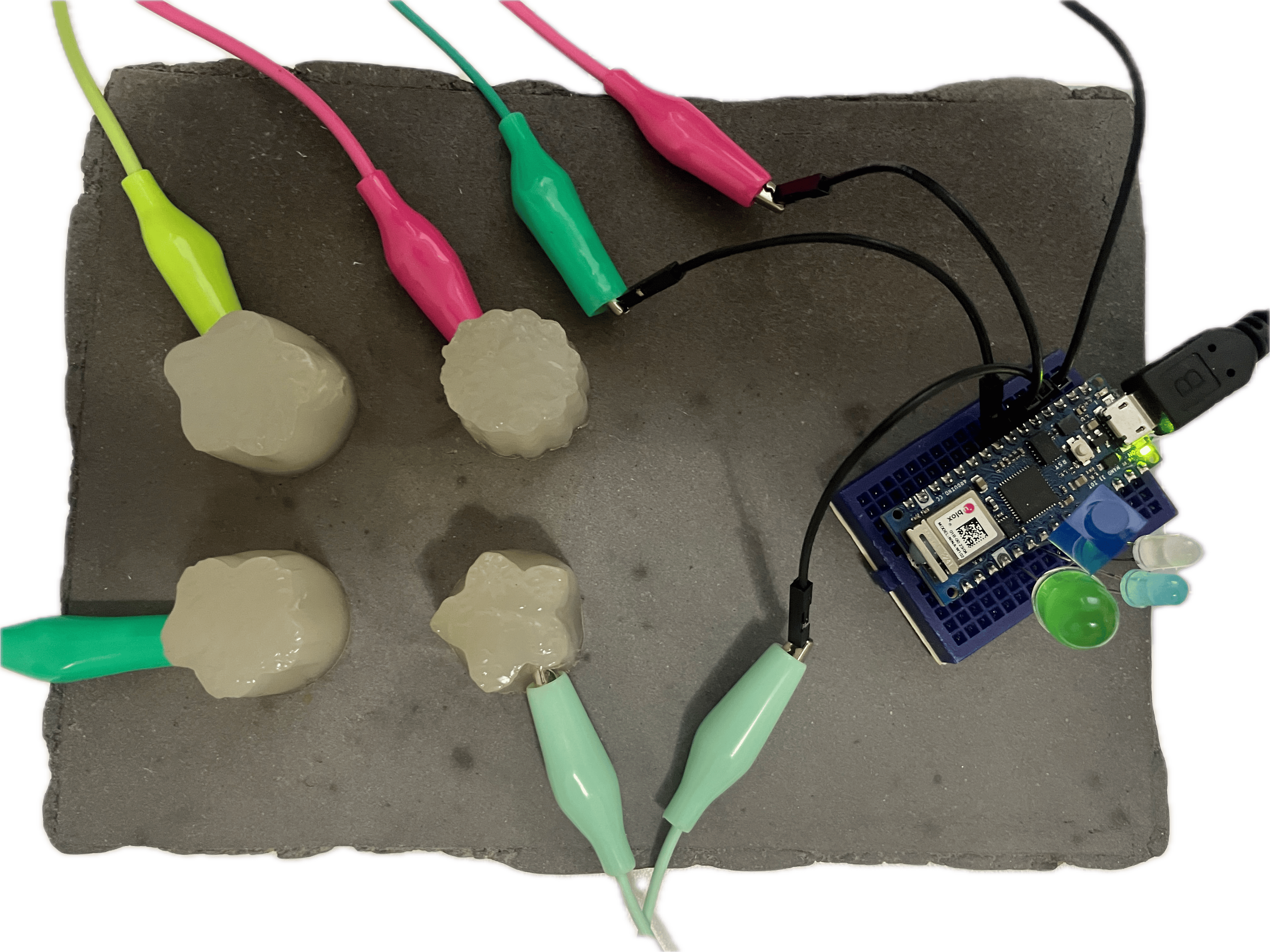
Soft biomaterial experiments with agar agar, Arduino, and ml5.js
Hello Blob: Agar as Interface, began as a material-driven experiment exploring whether a simple biomaterial like agar could function as an interactive computational interface. The project emerged during a series of playful tests combining soft materials, physical computing, and ml5.js, an open source machine learning library designed for artists and creative coders.
ml5.js makes machine learning approachable by allowing models and interactive behaviors to run directly in the browser. Its emphasis on experimentation rather than optimization provided an ideal environment for investigating unconventional sensing materials and unstable inputs.
Instead of treating sensing as a purely hardware problem, this experiment asked a different question: how might a soft, deformable biomaterial participate in interaction when coupled with lightweight browser-based machine learning tools?
project repository: https://github.com/yafira/neural-nectar/
Concept
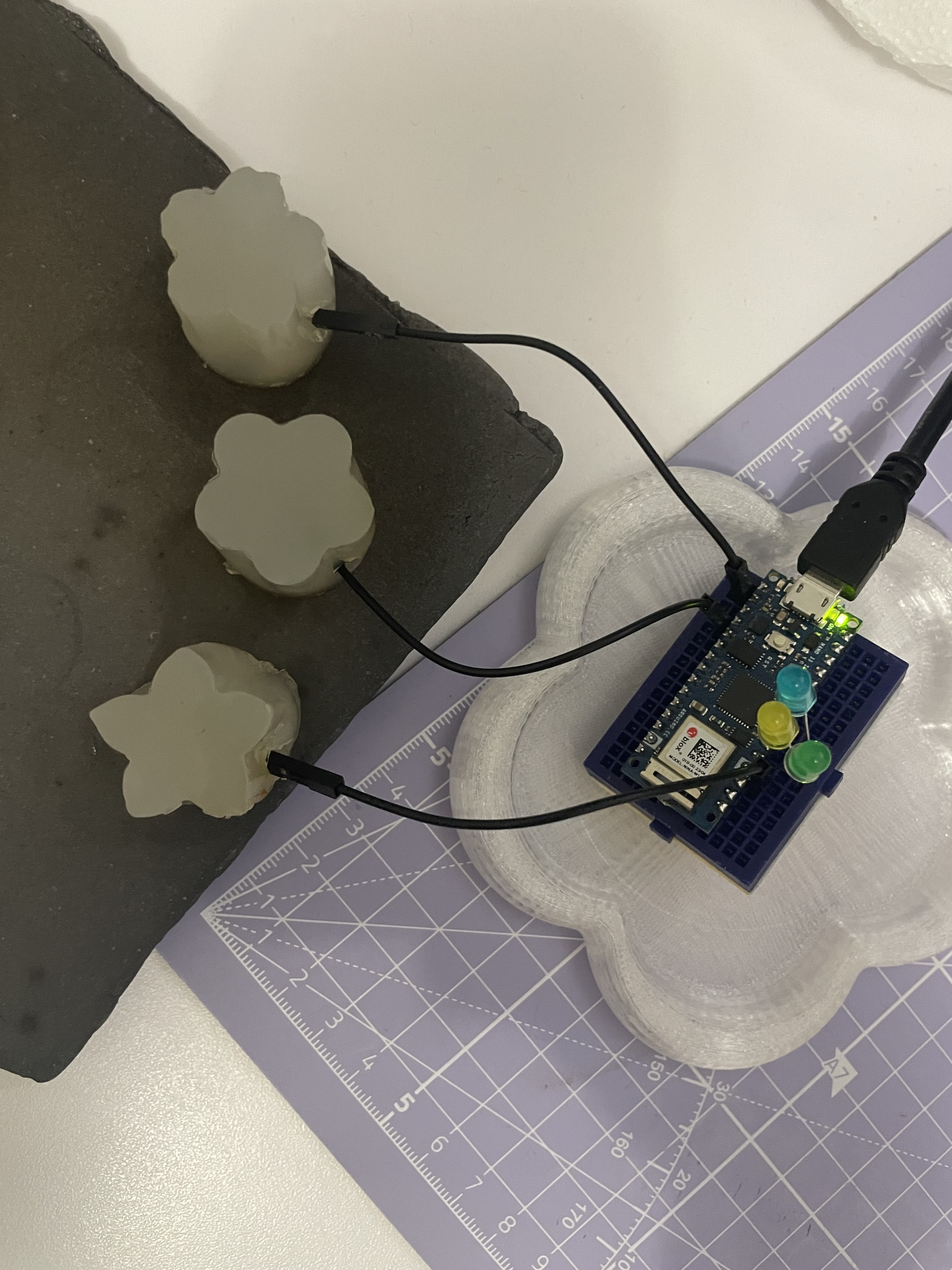
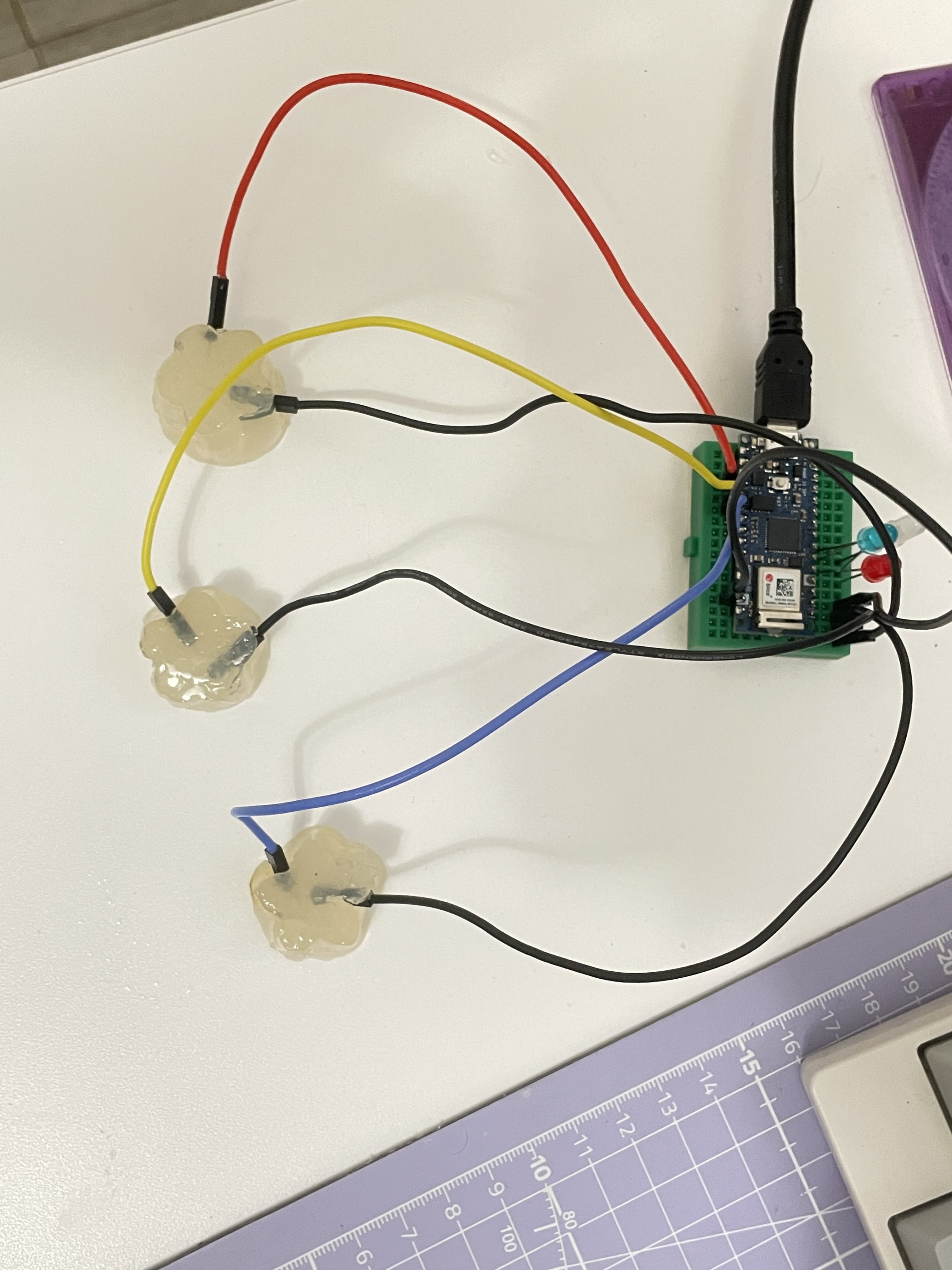
This project treats agar not as a passive substrate but as an active interface material. Small agar blobs were cast into soft bodies and embedded with conductive elements, allowing the material itself to mediate interaction.
To enable conductivity, salt was added directly to the agar mixture. Pure agar is largely non-conductive, but dissolving salt introduces ionic pathways that allow electrical variation to propagate through the material. This simple modification transforms the gel from an insulating structure into a responsive conductive body.
When connected to an Arduino analog input, touch and pressure generated fluctuating signal variations shaped by both material deformation and ionic behavior. These readings were streamed to the browser through Web Serial, where a minimal JavaScript sketch interpreted changes as interaction states.
In this configuration, the blob functions less like a precision sensor and more like a responsive, expressive interface surface.
Why Agar as Interface?
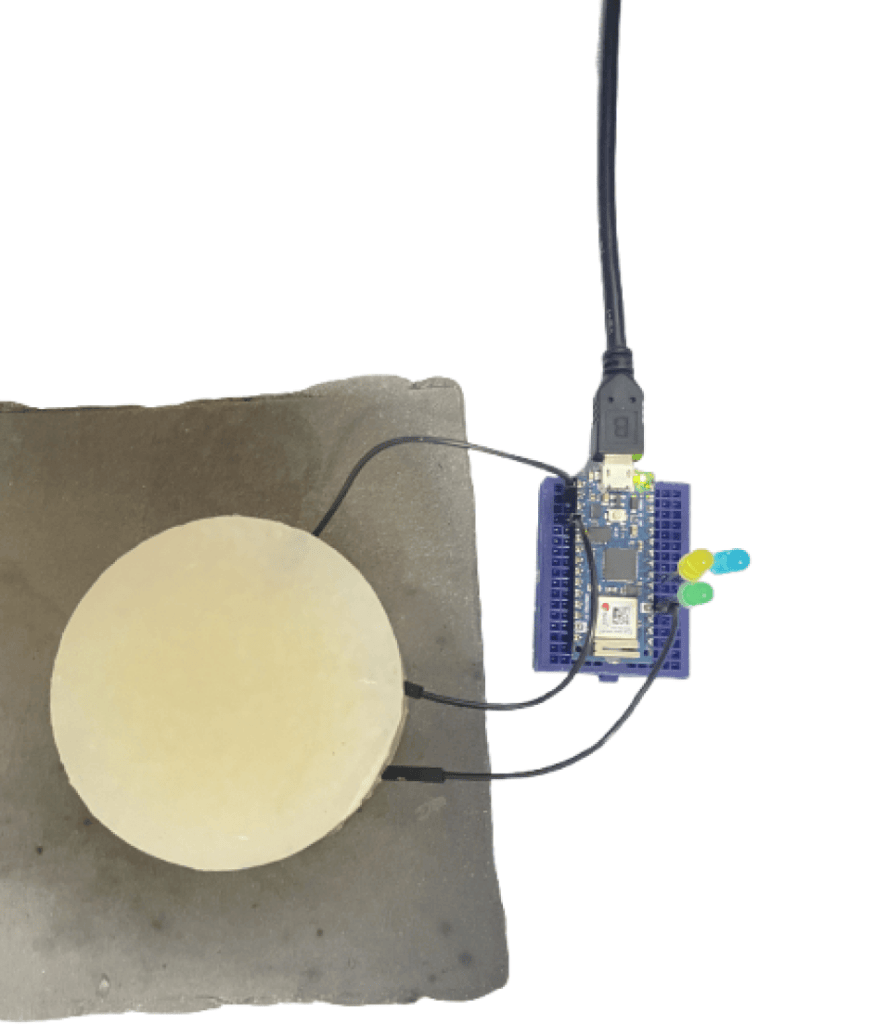
Agar is rarely considered an interaction material, yet it offers qualities that make it uniquely interesting for exploratory design:
-
Naturally soft and deformable
-
Easily cast into organic forms
-
Accessible and inexpensive
-
Ephemeral and unstable
-
Responsive to environmental conditions
Rather than resisting these properties, these blobs embrace them as part of the interaction logic.
What is ml5.js?
ml5.js is an open source machine learning library built on TensorFlow.js. It provides simplified APIs and pretrained models that run directly in the browser, making ML accessible for creative technology contexts.
For experimental interface work, ml5.js enables machine learning to function as a behavioral layer rather than a purely analytical system. It supports rapid iteration and unconventional input sources, including noisy or unstable signals.
System Architecture
The interaction pipeline followed a deliberately minimal structure:
Agar Blob → Arduino → Web Serial → Browser Sketch
-
Agar blobs act as deformable conductive bodies
-
Arduino samples analog variation
-
Values stream into the browser
-
JavaScript interprets interaction states
This architecture emphasizes responsiveness and behavior rather than measurement accuracy.
Interaction Logic

1

- The browser sketch monitors incoming analog values and applies a threshold model to interpret blob activity. When readings exceed a defined boundary, symbolic labels are generated to represent interaction states.
2. In this prototype, these states are mapped to a simple lighting response. Illumination functions only as a demonstration output rather than the primary focus of the system.
const sensorThreshold = 300;
if (sensorValues[0] > sensorThreshold) {
sendToArduino('blob1');
} else {
sendToArduino('none');
}
The thresholding mechanism intentionally preserves instability, allowing fluctuations to become part of the interaction character.
While this implementation relies on fixed thresholds, the experiment is motivated by a broader interest in machine learning-driven interaction. A natural extension of this work involves replacing manual thresholds with an ml5.js classification model capable of learning blob interactions directly from sensor variation. Rather than defining interaction boundaries numerically, an ML system could infer states such as touch intensity, gesture patterns, or interaction types from examples.
Material Behavior
INGREDIENTS >
• Agar agar flakes >
• Water >
• Heat source >
• Mold/casting surface or cookie cutter! >
• Conductive insert (wire, foil, or conductive fabric) >
• Arduino (analog input)METHOD
Prepare agar mixture using water and agar powder (flakes)
Add salt (approximately 1–2 tsp per cup of water) to enable ionic conductivity
Heat until fully dissolved
Pour into blob form or mold
Embed conductive element before gel sets
Connect conductor to Arduino analog pin
Read signal variation from touch or pressure
Working with agar as an interface reveals behaviors distinct from conventional sensors:
-
Signal drift and noise
-
Sensitivity to moisture and touch
-
Nonlinear response patterns
-
Expressive tactile qualities
The blob behaves less like a fixed device and more like a dynamic material system.
OBSERVATIONS /
-
Highly sensitive to moisture and environment
-
Readings may fluctuate or drift over time
-
Material encourages playful, tactile interaction
-
Suitable for experimental and educational contexts
Reflections
These conductive blobs reframe sensing as a material interaction study. Agar is not simply a container for electronics. Its softness, hydration, and instability actively shape computational behavior.
Within an ml5.js experimentation context, this unpredictability becomes generative. Noise and fluctuation introduce variability that rigid interfaces typically suppress.
Conclusion
These blobs demonstrate how even simple biomaterials can function as expressive computational interfaces. By foregrounding material behavior rather than stability, the project expands how interaction surfaces might be conceived.
Softness, variability, and impermanence become design parameters rather than constraints.
Relative Resources:
Science / Technical Background
- “Comparison of Electrical Conductivities of Various Brain Phantom Gels” (PMC/NIH) — This is actually the most directly relevant academic source. It studies how NaCl concentration from 0–1 mg/ml affects the conductivity of agar, agarose, and gelatin gels, finding that conductivity increases linearly with salt concentration. It’s the scientific backbone for exactly what your blob does.
PubMed Central →pmc.ncbi.nlm.nih.gov/articles/PMC3489480/
Maker / DIY Context
-
TeachEngineering: “Build and Test a Conductivity Probe with Arduino”
A hands-on activity guide where students construct conductivity probes and connect them to Arduino to test salt water vs. sugar water. Good precedent for the DIY approach you took.
TeachEngineering →teachengineering.org/activities/view/nyu_probe_activity1 -
Hackaday: “Conductive Gel Has Potential” — Covers a maker project using saline gel and xanthan gum in tubes as unconventional circuit elements, where the gel’s ability to move and engage different parts of a circuit is highlighted as something copper wire couldn’t do. Resonates with Hello Blob’s spirit.
Hackaday →hackaday.com/tag/conductive/
HCI / Soft Interfaces
“Agar-made Artificial Skin with Integrated Optical Fiber Tactile Sensor” (ScienceDirect, 2025) — A recent paper introducing agar film as a soft tactile interface for human-computer interaction, emphasizing its biocompatibility and biodegradability. Directly validates agar as an HCI material.
ScienceDirect → sciencedirect.com/science/article/abs/pii/S0924424725007666
more ++:
https://www.sciencedirect.com/science/article/abs/pii/S1385894722053220
https://ieeexplore.ieee.org/document/10560575
https://link.springer.com/article/10.1007/s10853-023-08344-3