Poetic Pattern Recognition
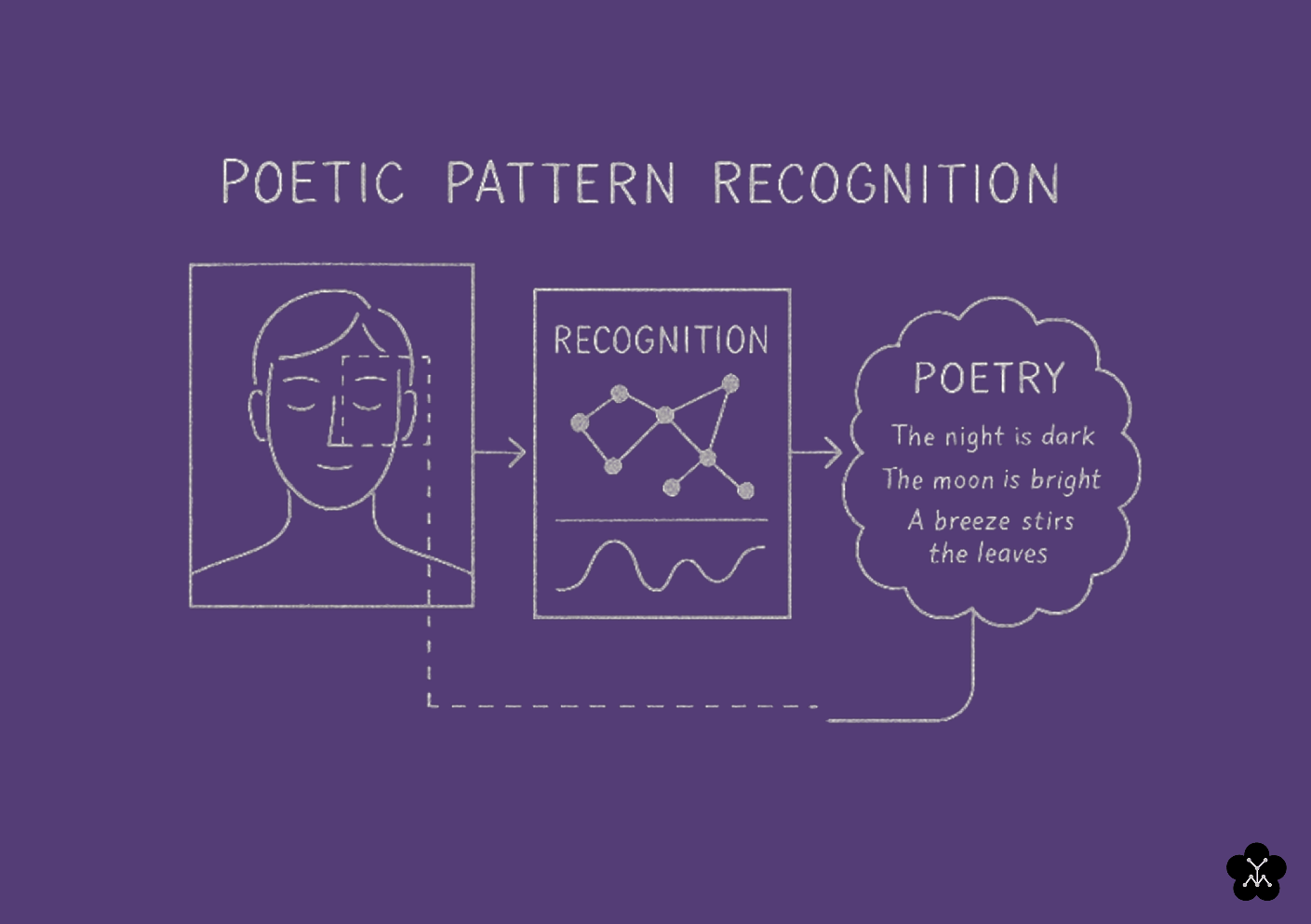
On finding meaning where logic meets resonance
“We are not machines, but we speak their language in whispers and rhyme.”
Every day, we live among patterns. Some are obvious—like the flicker of lights at dusk or the rhythm of keys when we type. Others are subtle: a hesitation before a smile, the pauses in conversation, the way we scroll a little slower on certain pages. These patterns are not just data, they’re stories.
In machine learning, pattern recognition is a process: identify, classify, predict. But what happens when we apply a poetic lens to this recognition? What if the patterns we notice aren’t just functional, but charged with resonance—with memory, metaphor, and meaning?
This idea—the entanglement of computation and sensibility is what I’ve decided to call Poetic Pattern Recognition. I have no idea if this term already exists; I didn’t search it and honestly, I’m enjoying the brief fantasy of having coined something original. Let’s just pretend I did. Below is a manifesto for this not-quite-official practice: a creative guidepost for artists, coders, and dreamers who are building systems that perceive more than just inputs and outputs—systems that might stumble into something stranger, softer, or more beautiful along the way.
✶ Manifesto: Poetic Pattern Recognition
We are not machines, but we speak their language in whispers and rhyme.
-
The world is not random.
It breathes in patterns, waves, rhythms, habits, data and we, as poets, sense it before we understand it. -
Recognition is interpretation.
Pattern recognition is not sterile. It is textured. To see a shape is to perceive its presence. -
Poetry is code.
Like syntax in motion, meaning arises from constraint. Let stanzas be loops, enjambment be logic. -
Code is poetry.
Every line holds intention. Elegance matters. The best algorithms hum like sonnets. -
We honor error.
The glitch, the aberration, the unexpected output; these are stanzas we did not mean to write, but must read anyway. -
We seek systems with soul.
Our machines do not only analyze. They observe, drift, and sometimes misremember with grace. -
Data becomes intimacy.
We trace the pulse of a city in its traffic flows, the longing of a user in their late-night searches. -
A neural net can be a mirror.
Trained not to imitate but to reveal—our habits, our oddities, our unspoken logic.
We are pattern seekers. But let our patterns be poetic.
Let our recognition be more than classification—let it be communion.
✶ A Living Practice
To bring this manifesto to life, I’ve been thinking about interactive systems where recognition and poetry converge:
✿ A webcam mirror that reflects your mood back as a shifting haiku.
✿ A wearable that writes poetry based on your movement patterns.
✿ A tide of generative text that rises and falls with your voice.
✿ A moon phase display that pairs lunar data with lunar verse.
These aren’t just interfaces. They’re quiet collaborators. They notice. They respond. They make space for resonance.
✶ Towards a more poetic machine…
Poetic pattern recognition isn’t a framework with deliverables or KPIs. It’s a way of noticing, of paying attention—a practice of building systems that search not just for answers, but for moments of curiosity, slowness, and surprise.
If machine learning is how machines parse the world, then poetic pattern recognition is how we conspire with them to make sense of it—through metaphor, through ambiguity, through a little bit of wonder.
✿ Let us code like poets.
✿ Let us treat data not as fact, but as invitation.
✿ Let us recognize patterns the way we recognize a familiar face in a crowd—with warmth, with curiosity, with a readiness to be changed.